TCP/IP networks are the most common type of network today. With such a network, a number of computers or nodes can communicate with each other. An important aspect of this communication is routing: getting data packets from one node to another, in particular from one node on one network to another node on another network.
Nodes, hubs and switches
A network is a collection of computers or other devices, commonly called nodes, that are able to communicate with each other. This communication takes place on different network levels. A network may use the Internet Protocol (IP) at one level and Ethernet at the level directly below it. This distinction is important because some parts of the network operate at the IP level and others at the Ethernet level.
The most common type of network (especially in the home) is the Ethernet network shown in figure 1, where all nodes are connected to a central device. In its simplest form this central node is called a hub.

Figure 1: a basic network architecture
Basically, a hub is a box with lots of connections (sockets) for Ethernet cables. The hub repeats all messages it receives to all connected nodes, and these nodes filter out only the messages that are intended for them. This filtering takes place at the Ethernet level: incoming messages carry the Ethernet network address of the intended recipient.
A problem with this approach is that hubs generate a lot of traffic, especially on larger networks. Most of this traffic is wasted, since it is intended for only one node but it is sent to all nodes on the network.
A commonly used solution today is a switch. A switch still connects all nodes to each other, like a hub, but is more intelligent in which messages are passed on to which node. A switch examines incoming Ethernet messages to see which node is the intended recipient, and then directly (and only) passes the messages to that node. This way other nodes do not unnecessarily receive all traffic.
Since switches are more expensive than hubs, a low-traffic part of the network could be set up using a hub, with the more high-traffic nodes being interconnected to the switch. The hub segment is then connected to the switch as well, as shown in figure 2.
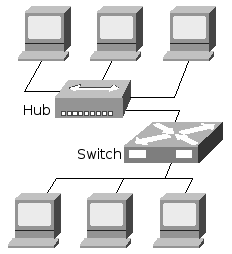
Figure 2: a basic network with a hub and a switch
Segments and bridges
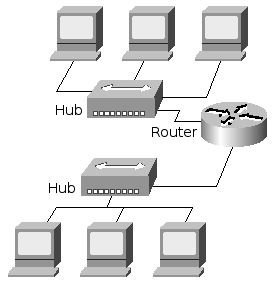
A large network can be divided into multiple parts which are calledsegments. Each segment can use its own network protocol, securityrules, firewalls and so on. Nodes on different segments cannot directly communicate with each other. To make this possible, a bridge is added between the segments, as shown in figure 3.

Figure 3: two network segments connected via a bridge
The bridge lets packet pass that are destined for a host on the other side. This seems to turn the two segments into one big network again, but there is an important difference. Data packets generated on one segment and intended for that same segment are not passed to the other segment. This saves on data transmission on the network as a whole.


No comments:
Post a Comment